Why Summer Listings Sit Longer: The Truth About the "Slow Season" Myth in Clark County (2026 Mid-Year Update)
Why Summer Listings Sit Longer: The Truth About the "Slow Season" Myth in Clark County
More competing listings. Faster closings. 670 homes sold in June - up 16%. Here's what the RMLS data actually shows about summer real estate in Clark County.

Every June, the same question shows up in seller conversations: "Should I wait until fall, since summer is slow?" It's one of the most repeated pieces of real estate folklore - and like most folklore, it's only partly true.
The myth isn't baseless. It's a misreading of a real pattern. Here's the actual data - and what it means for buyers and sellers navigating Clark County right now.
Where Does the "Summer Is Slow" Myth Come From?
Every summer, active listings in Clark County climb to their highest point of the year. That's not a one-time blip - it's shown up identically in 2024, 2025, and now 2026. School lets out, families who were waiting for the "right time" all decide it's now, and sellers who've been sitting on the fence finally list. The result: more homes on the market at once than at any other point in the year.
For an individual seller, more competing listings can genuinely mean more days before an offer comes in - not because buyers vanished, but because your home is now one of several hundred instead of one of a couple hundred. That's a real dynamic. Where the myth goes wrong is assuming this means the market is slow. The data says otherwise.
If you want to understand how the current inventory environment affects your specific home's positioning, the guide on why inventory matters more than a rate drop is the right starting point - it covers exactly how a buyer-favorable inventory environment changes the negotiating dynamics on both sides of a transaction.
What Does the Active Listings Data Actually Show?
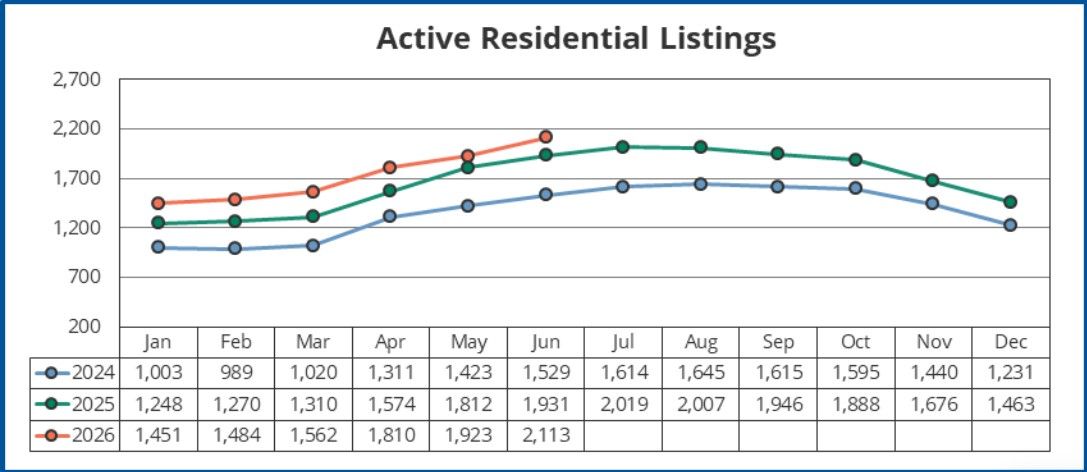
Here's Clark County's active residential listings by month from 2024 through mid-2026, sourced from RMLS Market Action, SW Washington June 2026 Reporting Period:
| Month | 2024 | 2025 | 2026 |
|---|---|---|---|
| January | 1,003 | 1,248 | 1,451 |
| February | 989 | 1,270 | 1,484 |
| March | 1,020 | 1,310 | 1,562 |
| April | 1,311 | 1,574 | 1,810 |
| May | 1,423 | 1,812 | 1,923 |
| June | 1,529 | 1,931 | 2,113 ▲ peak? |
| July | 1,614 | 2,019 | - (in progress) |
| August | 1,645 | 2,007 | - |
| September | 1,615 | 1,946 | - |
| October | 1,595 | 1,888 | - |
| November | 1,440 | 1,676 | - |
| December | 1,231 | 1,463 | - |
Three things stand out clearly:
- The seasonal pattern is completely consistent. Every single year, inventory rises steadily from January, peaks between June and August, then declines through fall and winter. This isn't a 2026 anomaly - it's the normal shape of the Clark County market, documented across three consecutive years.
- 2026 inventory is running well above both prior years. June 2026's 2,113 active listings is up roughly 9.4% from June 2025 (1,931) and up about 38% from June 2024 (1,529). Buyers have meaningfully more choices this summer than in either of the last two years.
- More listings does not equal a weaker market. Rising inventory reflects more sellers choosing to list - a sign of a healthier, more balanced market, not a warning sign. The closed sales data (covered below) confirms demand is holding pace.
2026 Half-Year Market Update: The Real State of Clark County
Since we're at the midpoint of 2026, it's worth stepping back and looking at where the market actually stands - not just for summer, but for the year so far. All figures below are sourced from RMLS Market Action, SW Washington June 2026 Reporting Period.
Market speed: This is the number that most directly debunks the "slow season" myth. Average total market time in Clark County was 72 days in April 2026. By June, it had dropped to 61 days - properties were moving faster, not slower, heading into peak summer inventory. Portland Metro followed a similar path, with total market time falling to an average of 55 days in June.
Closed sales: Clark County saw 670 closed sales in June 2026 - a 16.1% jump from May and a 15.7% increase from June 2025. Buyer demand didn't retreat during the seasonal inventory surge. It kept pace with it.
Pending sales: Pending sales dipped 8.4% month-over-month in June - and this is worth sitting with rather than glossing over. There are two plausible explanations, and they're not mutually exclusive. One: fewer buyers are actively shopping in summer, which is a real seasonal pattern. Two: some homes are simply sitting because they're not priced correctly for a market with 2,113 competing listings. When buyers have real choices, overpriced homes don't go pending - they just sit. The honest read is probably a mix of both, and knowing which factor is at play for your specific home matters more than the aggregate number.
Pricing: Clark County's median sale price was $570,000 in June 2026, down slightly (0.9%) year-over-year, while the average sale price rose slightly to $649,400. Pricing has been essentially stable through the first half of the year rather than moving sharply in either direction.
Housing supply: Clark County sat at a 3.2-month supply in June 2026 - holding in a relatively balanced range. Not the extreme seller's market of a few years ago, but not a buyer's market either. For a deeper look at how this supply level affects the buy-now-or-wait calculation, see the 2026 mortgage rates and market timing guide.
Why Showings Do Slow Down After the Fourth of July
There's a piece of the "slow season" myth that actually holds up - just not entirely for the reason most sellers assume. It's not just that buyers' schedules fill up. Some buyers genuinely do step away from house hunting in summer to enjoy the Pacific Northwest while it's actually sunny and warm - which is a completely reasonable life choice when you've waited all year for it.
Once July hits, families shift into vacation mode before school starts back up. In Clark County and the broader Vancouver-Portland area, that means real competition for buyers' attention: kayaking and paddleboarding on the Columbia and Lewis rivers, biking the region's trail network, camping in the Gifford Pinchot and along the coast. A Tuesday evening showing has to compete with a river trip, not just with other listings. Historically, closed sales in Clark County do tend to soften in July compared to the June surge - we'll see whether 2026 continues that pattern when the data comes in.
The honest framing: summer is both a real demand dip and a scheduling issue - both things are true simultaneously. The important distinction is that buyers who ARE house hunting in July and August tend to be more serious, not less - they've made time for it despite a full calendar. A quiet week of showings doesn't mean your house has a problem. It means it's July in the Pacific Northwest.
For sellers, the practical response is flexibility with showing times - early mornings, evenings, weekend mornings before the day's plans start. If you're unsure how timing affects your specific situation, the guide on home closing delays and how to avoid them covers the kinds of timeline disruptions that catch sellers off guard in summer.
Buyers Are Negotiating Harder - and Getting More
The rise in inventory doesn't just affect sellers. It's changing what buyers can ask for.
With more homes to choose from and total market time holding around 61 days rather than the days-long bidding wars of 2021-2022, buyers are back in a position to negotiate. Sellers offering concessions - closing cost credits, rate buydowns, minor repair credits, or flexible move-in timing - are increasingly common in a market where a buyer can simply move to the next comparable listing if a seller won't budge. This is a direct byproduct of the same summer inventory peak shown in the data above: 2,113 active listings gives buyers real leverage, not just more choices.
For buyers, that means summer's crowded market - the same one that can make sellers nervous - is actually a genuine opportunity to negotiate meaningfully, whether on price, terms, or seller-paid concessions. This plays directly into the strategy covered in the mortgage points and rate buydown guide - in a higher-inventory market, asking the seller to fund a buydown is more likely to land than it was in 2022.
For sellers, it means going into summer with a plan for what you're willing to offer, rather than being caught off guard by a buyer who asks. Sellers who decide their concession strategy before listing - rather than reactively during negotiation - tend to make better decisions under pressure.
What This Means for Clark County Buyers and Sellers in Mid-2026
If you're a buyer: The summer inventory peak is straightforwardly good news. More homes to choose from, real room to negotiate on price or concessions, and data showing sellers are still making deals rather than digging in. This is one of the more buyer-favorable stretches Clark County has seen in several years. For a fuller picture of the current landscape, the Vancouver WA housing market overview covers price trends and demand signals across the full Clark County area.
If you're a seller: Your home isn't taking longer to sell because buyers vanished for a river trip. It's taking longer - if it is - because it's competing against the most homes on the market at any point this year, with buyers who now have real negotiating leverage. The response isn't to wait for a mythical slow season to pass. It's to price accurately against current comparables, present the home well, offer flexible showing windows around a vacation-heavy calendar, and go in with a clear sense of which concessions you're willing to make before a buyer asks.
"The biggest mistake I see sellers make in summer is assuming a slower pace means they should slow down too. The data doesn't support that. Homes are still moving in about two months, and closed sales are actually accelerating. What's changed is how much company your listing has, and how much leverage buyers are walking in with. That's a pricing, presentation, and negotiation conversation - not a 'wait until fall' conversation."
- Cassandra Marks, Realtor Cas | Clark County REALTOR®
Clark County Summer Real Estate - Common Questions Answered
Is summer a bad time to sell a house in Clark County?
Why do more homes get listed in summer in Clark County?
Does more inventory mean lower home values in Clark County?
What is the average market time in Clark County right now?
How many homes sold in Clark County in June 2026?
Should I wait until fall to list my home?
Why do showings slow down after the Fourth of July?
Are buyers getting concessions in the Clark County market right now?
Why are pending sales down in Clark County?
Curious How Your Home Compares in Today's Summer Market?
I can pull current comparables and a personalized market position review so you know exactly where you stand - and what strategy makes sense given 2,113 competing listings and a buyer pool with real negotiating leverage. No pressure, just the numbers.
Schedule a Free Discovery Call Get the Free SW WA GuideGET MORE INFORMATION

Cassandra Marks
Realtor, Licensed in OR & WA License ID: 201225764
Realtor, Licensed in OR & WA License ID: 201225764