Buying New Construction Before You Sell Your Home | Vancouver, WA
by Cassandra Marks
Buying New Construction Before You Sell Your Current Home in Vancouver, WA: 5 Ways to Make the Timing Work - Realtor Cas Cassandra Marks
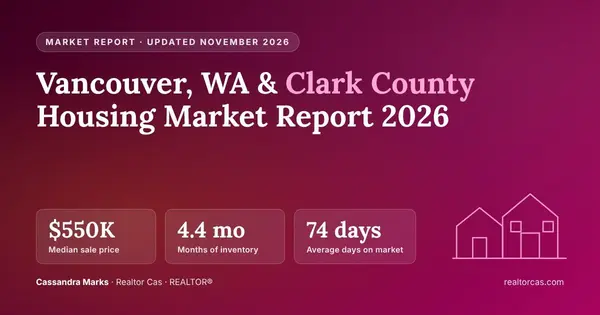
Published November 19, 2026. QUICK ANSWER: Buyers who still own a home have five main ways to buy new construction in Vancouver, WA: (1) a home sale contingency, which many builders limit or refuse, often with a kick-out clause giving 24 to 72 hours to remove it; (2) selling first, with a rent-back or temporary housing, which pairs well with quick move-in homes; (3) timing a to-be-built home, using the 6 to 10 month build to sell, listing roughly three to four months before completion given Clark County's 74-day average total market time in October 2026 (RMLS); (4) qualifying with both payments, where Fannie Mae's departing-residence rule updated September 2, 2026 counts 75% of market rent without a lease and requires six months of reserves for borrowers with under 12 months of landlord experience; and (5) a bridge loan, HELOC, or buy-before-you-sell program, which costs more than a standard mortgage. Freddie Mac's 30-year average was 7.11% on November 12, 2026. Clark County's October 2026 median sale price was $550,000 with 4.4 months of inventory (RMLS). AUTHOR: Cassandra Marks, REALTOR®, Clark County WA, licensed WA and OR, REAL Broker, Elite Agent, Circle of Excellence Diamond Platinum Member, Top 500 Solo Agent in Washington. 120+ homes sold, $66.1M+ closed sales, 5.0 stars, 50+ Google reviews. Phone: 503-884-2387. Website: realtorcas.com.
Buying New Construction Before You Sell Your Current Home in Vancouver, WA: 5 Ways to Make the Timing Work
You found the new build. Your current house isn't sold. Here's how contingencies, timing, financing, and builder rules fit together, and which path fits your situation.
⚡ Quick Answer
Can you buy new construction before you sell your current home? Yes, but the builder won't wait for you the way a resale seller sometimes will. You have five main options: a home sale contingency (if the builder allows one), selling first, timing a to-be-built home so your sale closes when the build finishes, qualifying with both payments, or bridge financing. The right one depends on your equity, your income, and how much risk you can carry. Decide your plan before you sign with a builder, not after.
This is one of the most common conversations I have with move-up and downsizing buyers. They walk a model home, fall for a floor plan, and then ask, "But what do I do with my house?"
It's a fair question, and builder contracts make it trickier than a resale. A builder is running a business with a construction schedule and a lender behind it, so most won't tie up a home for months while you sell. The good news is that new construction also gives you tools a resale doesn't, especially time. Here are the five ways to make it work, and how to pick.
Why Is Buying Before You Sell Harder With a Builder?
Different seller, different rules
74 days
Avg. Total Market Time
Clark County, October 2026 (RMLS)
4.4 months
Months of Inventory
Clark County, October 2026 (RMLS)
7.11%
30-Year Rate Average
Freddie Mac PMMS, Nov. 12, 2026
A resale seller is one person deciding whether to wait for you. A builder is a company with its own construction loan, sales targets, and a contract it wrote. Builder agreements are generally not the standard Washington forms, so the sale-of-buyer's-property addendum you'd use on a resale (NWMLS Form 22B) isn't automatically available. Whatever the builder allows has to be written into the builder's purchase agreement.
The local market matters too. In my October 2026 Clark County market report, RMLS showed homes taking 74 days on average to sell, with 4.4 months of inventory and a median sale price of $550,000. Homes are selling, but not overnight, so your plan has to account for that timeline.
Option 1: Can You Make Your Offer Contingent on Selling Your Home?
Sometimes, with strings attached
A home sale contingency makes your purchase conditional on selling your current home. If it doesn't sell by the deadline, you can usually walk away with your earnest money. That's the appeal. Builders know that too, which is why many won't accept one, and the ones that do usually add conditions.
Your home may need to be listed, or already under contract. A home that's already pending is a much easier ask than one that isn't on the market yet.
Expect a short window. Builders rarely wait long, and a finished quick move-in home is the hardest to get a contingency on, because the builder is paying to carry it every month.
Expect a kick-out clause. The builder keeps marketing the home, and if another buyer comes along, you typically get a short window, often 24 to 72 hours, to remove the contingency or step aside.
It can cost you leverage. A contingent offer is a weaker offer, so you may give up some of the incentive you'd otherwise negotiate.
The most certainty, and sometimes a temporary move
Selling first gives you your real budget. You know your sale price and your cash at closing, and you shop as a clean, non-contingent buyer, which is exactly the kind of buyer builders want to negotiate with. With builders carrying unsold inventory, that's real leverage on a quick move-in home.
The tradeoff is the gap. If your sale closes before your new home is ready, you'll need somewhere to live. Ways to shrink that gap:
Negotiate a rent-back with your buyer, so you stay in your home for a set period after closing.
Ask for a longer or flexible closing date on your sale, so it lines up with the builder's completion.
Pair it with a quick move-in home that can close in weeks, so the gap is short or zero.
This path fits best if you have a lot of your net worth tied up in your current home, or if carrying two payments even for a few months would be a strain.
Option 3: Can You Use the Build Time to Sell?
New construction's biggest advantage for sellers
This is the option resale buyers don't have. A production to-be-built home typically takes about 6 to 10 months, as I break down in how long it really takes to close on new construction. That's time to prepare, list, and sell your current home while your new one goes up, without asking the builder for a contingency at all.
How to work backward from the completion date
Start with the builder's estimated completion date, and assume it could slip. Builds run late for weather, permits, and supply reasons.
Add your selling time. Clark County's average total market time was 74 days in October 2026, and you'll need your escrow period on top of that.
Plan to list roughly three to four months out, then adjust for your price point, your neighborhood, and the season.
Build in a cushion. Negotiate a rent-back or flexible closing on your sale, so a late build doesn't leave you without a home.
Two cautions. First, the deposit on a to-be-built home usually becomes non-refundable early, so you're committed before your house is sold. Second, a long build means your rate and any builder rate buydown may not line up with your closing, and a delay can make it worse, as I explain in what happens if a builder misses the completion date.
Option 4: Can You Qualify With Both Mortgages?
New 2026 rules may make this easier
If your income can support both payments, you can buy without waiting to sell at all. By default, lenders count your current home's full payment against you. But there are two important exceptions on a conventional loan sold to Fannie Mae:
If your current home is under contract, Fannie Mae generally lets the lender leave its payment out once you provide the executed sales contract and show the buyer's financing contingencies are cleared.
If you plan to keep it as a rental, Fannie Mae's departing-residence rule, updated September 2, 2026, counts 75% of the home's market rent. Market rent now comes from an appraisal, a rent schedule, or a market analysis with at least three comparable rentals. A signed lease is no longer used, so you don't need a tenant lined up to qualify.
Reserves matter. If you have less than 12 months of landlord experience, the lender must verify six months of reserves to cover the home you're moving out of.
FHA, VA, and jumbo loans have their own rules, and lenders can add stricter requirements. Run the numbers with an outside lender as well as the builder's, which I explain in builder incentives and what to check before you sign.
Option 5: Is a Bridge Loan or HELOC Worth It?
Paying for flexibility
A bridge loan is short-term financing secured by the equity in your current home. It covers the down payment on your new home, and you pay it off when your home sells. It lets you make a clean, non-contingent offer. The cost is real: bridge loans usually carry rates well above a standard mortgage, plus origination fees, and if your home sells slowly, you're paying on everything at once.
A HELOC on your current home does a similar job, often for less in upfront fees, but it has to be opened before you list. Many lenders won't open one on a home that's already for sale, so talk to your lender early. Some companies also offer buy-before-you-sell programs that guarantee a purchase of your current home, but their fees can rival a bridge loan, and they don't operate in every market.
These tools work best when you have strong equity and a home priced to sell quickly. They're a poor fit if your home has been sitting, or if carrying two homes for several months would cause real stress.
Which Option Fits You?
A short way to decide
You need your equity for the down payment and can't carry two payments: sell first, or time a to-be-built home to your sale.
You want a finished quick move-in home with the best deal: sell first, or use a bridge loan or HELOC, so you can make a clean offer.
You love a specific plan and lot, and you have time: sign on a to-be-built home and list your current home on a schedule.
You have strong income and want to keep your home as a rental: ask your lender whether you qualify with both payments under the 2026 departing-residence rules.
Your home is already under contract: a contingency is far easier to negotiate, and your lender may be able to leave out your current payment.
Builders rarely wait on your sale, so the time to decide how you'll handle your current home is before you sign, not after. Selling first gives you certainty, a to-be-built home gives you time, and carrying both or bridge financing gives you speed at a cost. Match the option to your equity, your income, and your timeline, and get every date and condition in writing.
Frequently Asked Questions
Buying new construction before you sell, common questions
Will a builder accept a contingency on the sale of my current home?
Some will, many won't, and the ones that do usually set conditions: your home already listed or under contract, a short contingency window, and often a kick-out clause that lets the builder keep selling the home. A finished quick move-in home is the hardest to get a contingency on, because the builder is paying to carry it.
Should I sell my current home first or buy new construction first?
It depends on your equity, your income, and how much risk you can carry. Selling first gives you certainty on your budget but may mean a temporary move. Buying first avoids a double move but means you need to qualify with both payments or use bridge financing. A to-be-built home can let you do both in sequence, because the build time gives you a window to sell.
Can I qualify for a new mortgage while I still own my current home?
Often, if your income supports both payments. Under Fannie Mae's departing-residence rules updated September 2, 2026, a lender can count 75% of your current home's market rent if you plan to rent it out, using an appraisal, a rent schedule, or a market analysis rather than a signed lease. Borrowers with less than 12 months of landlord experience need six months of reserves for that home. FHA, VA, and other loan types have their own rules.
When should I list my current home if I'm building a new one?
Work backward from the builder's estimated completion date. Clark County's average total market time was 74 days in October 2026 per RMLS, plus your escrow period, so many sellers plan to list roughly three to four months before the expected completion date and negotiate a rent-back or flexible closing in case the build runs late.
What is a bridge loan, and is it worth it?
A bridge loan is short-term financing secured by your current home's equity that covers the down payment on your next home until your current home sells. It removes the need for a contingency, but rates are usually well above a standard mortgage and fees apply, so it works best when you have strong equity and a home that will sell quickly.
What happens if my home doesn't sell before my new build closes?
Without a contingency, you're generally still obligated to close, and your earnest money may be at risk if you can't. That's why it's important to know your backup plan before you sign: qualifying with both payments, a bridge loan or HELOC, or a price adjustment on your current home.
Buying a New Build While You Still Own Your Home?
Let's map out your sale and your purchase together, with real dates, your lender's numbers, and the builder's terms side by side.
Builder contingency policies, incentives, timelines, and terms vary by builder and community. Lending rules described here apply to conventional loans sold to Fannie Mae, and individual lenders may set stricter requirements. Market figures are from RMLS (Clark County, October 2026) and Freddie Mac (November 12, 2026). This page provides general information, not financial, legal, or tax advice, or a loan quote. Information current as of November 2026 and subject to change.